Norhybrid moves into scale-up with a new CEO and a wider partner network
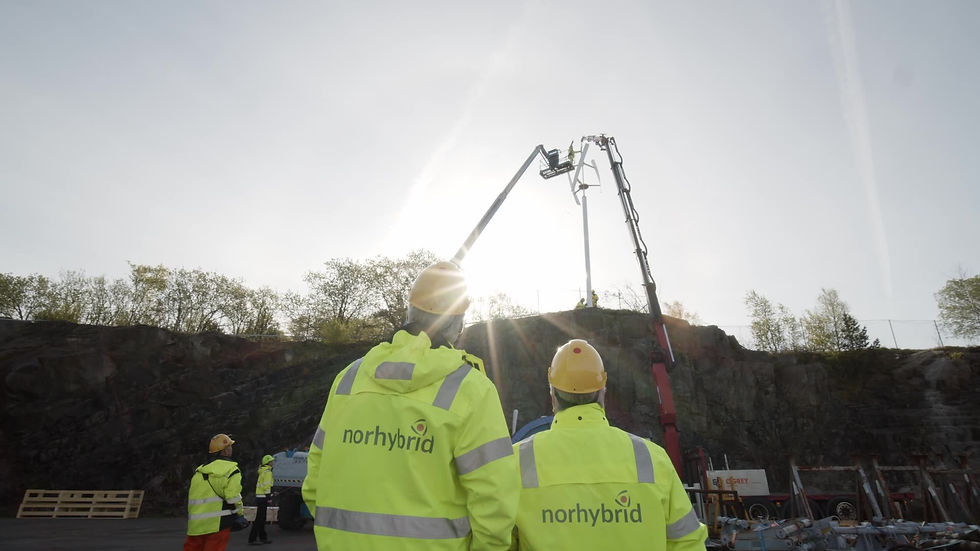
At Herøya in Porsgrunn, Norway, Norhybrid has built a 12-metre vertical-axis wind turbine for on-site generation, designed to scale industrially and to last 20-plus years. Pilot in 2023. First batch sold out. First installations in the field. The product is built. The next job is different: sales and delivery at volume.

That is why the company is moving into a new phase, a new CEO, a wider partner network, and hires to match.
Holmen built the foundation. He stays on the board.
Carl Ivar Holmen joined as an advisor from incubator Proventia when Norhybrid was still early. He was asked to judge whether the company was viable. He took over as CEO.
Under his leadership the product was designed, built, and brought to market.
“The work Carl Ivar led is why we have a turbine of this quality,” says Trond Sørensen, CEO of Norhybrid. “I joined at the start of 2023, when it was time to commercialise.”
Holmen also ran the finance and investor work, and used the Norwegian support system, Innovation Norway and other solutions, to fund product development. He is now returning to the fisheries sector, where he worked before. He remains on the board.
“We value that,” says Sørensen. “He stays a sparring partner with the rest of the board. Continuity, and a second pair of eyes on what we do.”
This is a handover, not a break. Sales and commercialisation now lead, as the company moves from startup to scale-up.
Trond Sørensen takes over as volume becomes the test
Sørensen has built several start-ups. He trained as an electrician and an engineer, then worked in software and sales before returning to energy, and to the Porsgrunn area, with Norhybrid.
The CEO role continues the approach the company has already built, with a sharper test: sales and delivery at volume.
“We have a few months to stand up the organisation and put the right people in the right roles,” he says. “Next year is the first real year of commercialisation. We need a product we can sell at a volume a startup cannot.”
That means stock on hand, the ability to deliver, and a higher conversion of leads. Norhybrid has spent recent years building the lead engine. Revenue now has to follow.
“The proof in the years ahead is to get sales and volume production running,” says Sørensen. “That is how production cost comes down, and margin improves. That is the proof the market will see, in sales, and in delivery.”
Roles are already going out this summer and into autumn: sales in key markets, a service engineer for operations and customer support, and a software architect to develop the customer systems further.
The UK and Ireland first — direct sales, with partners alongside
Norhybrid has a direct sales model in Norway and through partners abroad. To scale, the organisation will take more of the sales process itself, especially in England, Wales, Scotland and Ireland.
“We will have a sales organisation in the most important markets. We will not have a full delivery organisation,” says Sørensen. “We need partners to execute part of the work. Where we close the sale, we still draw on partners to deliver it.”
The partner network is expanding in parallel. The company is not locking into one model. Direct sales and partner delivery will run together.
The markets are deliberate. Wind is Norhybrid’s differentiator. Many can supply solar. Solar and wind together make a stronger year-round system: wind in winter when solar output is low, solar in summer when the wind is often weakest. Energy prices are also higher than in Norway, so the economics are easier to close.
“Succeeding there is the acid test of the concept,” says Sørensen.
The company is also looking at segments beyond agriculture and emergency response and, later, markets such as the US and Asia. The ambition is large. The pace will stay controlled. Norhybrid will not spread itself thin.
Local roots stay with the growth
Supporters at Herøya have followed the company since the incubator years. Proventia, where Norhybrid is based, and Telemark Utviklingsfond, which has backed the company with grants and loans, have taken the scale-up news well.
“They have backed us for a long time,” says Sørensen. “Now we scale, and we show that what we built here holds when the volume goes up.”
For partners and suppliers, the message is plain: organisation, sales and delivery now have to match the product already in the market. Continuity on the board. A clear direction in the market. The next proof is operational: more sales, more deliveries, and an organisation built for volume.