Therefore, local production of electricity is part of the combat capability
Transporting diesel to the front costs lives.

There are two drivers in a truck. The load is diesel. The road is known to the enemy, and predictable because it has to be. A convoy does not choose a new route every time. The convoy is driving towards a forward base that has no other power than what the diesel will be. Radar, sensors, heat, lights, small electronics: everything is holding its breath until the truck arrives. If it is stopped, the base is stopped.
That's the situation Trond Sørensen, CEO of Norhybrid, has in mind when he explains why local energy production is not a green ambition, but a risk-reducing measure. Modern warfare is powered by diesel, gunpowder and small electronics. The latter item is growing. The question for the defense leadership is not whether a forward base should have power, but how many times a truck must drive to have it.
– It is terribly dangerous to transport fuel in a conflict situation, with a great risk of loss of life, says Sørensen.
For Trond, the fact that a forward base has access to electricity is about three things.
– There is security of supply, energy security and soldier safety.
Soldiers on the front lines drive to the local electronics store
What Sørensen sees in modern warfare, where the technology soldiers use has grown faster than the supply chains that feed it, is that charging has become a logistics front in itself. Sensors, drones, cameras, radios: everything that has become essential on a modern base runs on batteries that need to be charged. In Ukraine today, the solutions are improvised.
– They go to the store and buy a small generator, says Sørensen.
– They run it around the clock, then it sits there simmering and charging batteries, and then they have charging pads with sockets to charge the various systems.
These are civilian components used in combination, because that's what soldiers do when their combat capabilities are sharpened by experience. They do what it takes to achieve their goal. Making sure that the small electronics are charged, just as much as the rifle. Sørensen believes that this is an insight that Norwegian authorities should consider before a similar need arises closer to home. He hopes that a lot of time is spent thinking about the logistics around power supply, as this is where the bottlenecks will lie.

Sun and wind complement each other in the north
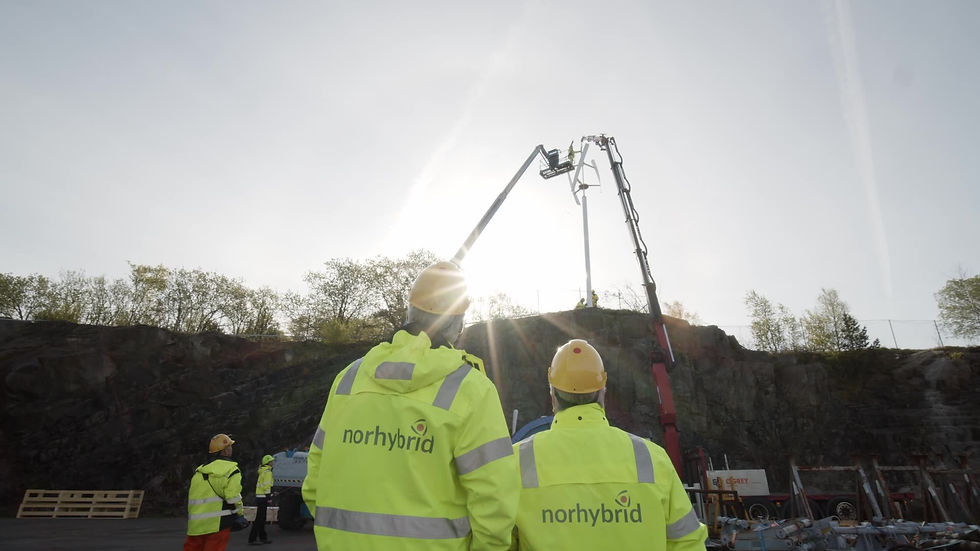
Norhybrid delivers what the company calls a hybrid system. It consists of vertical-axis mobile wind turbines at streetlight level, a foldable solar system, a mobile battery and an energy management system that ties the three together.
Sun and wind complement each other in a northern climate. Sun provides a lot in the summer, little in the winter. Wind produces more in the fall and winter. Combining the two, the variation in production drops significantly. A battery can withstand one to two days of endurance without production. For longer periods without both sun and wind, you must have a generator backup with diesel.
– The further away from the equator you get, the more you have to think about how you can combine wind, solar and batteries, says Sørensen.

Ørland Air Station tests facilities
At Ørland Air Station, Norhybrid's facility was up and running and producing within two days. A conventional installation with a concrete foundation takes months. The speed is not a curiosity; it is the prerequisite for what Norhybrid calls dual use, that the same system can serve defense, emergency preparedness and the civilian sector.

The facility on Ørland is there because the Norwegian Defence Construction Agency commissioned it. They are testing how vertical-axis wind turbines, mobile solar systems, mobile batteries and energy management systems work as one integrated facility. It is the Norwegian Defence Agency's own effort to test solutions that will increase energy security and independence in the field.
For Sørensen, the project is one of Norhybrid's most important. If the trial goes well, it could open the way for more deliveries where safety protocols are stricter than in a regular office space.
Every liter that must not be transported
Norway is part of a European defense cooperation where energy supply to forward bases is a stated goal. This is where Sørensen believes the hybrid concept will be put to the test.

“Renewable energy is not just about having a green footprint. It is about security of supply and safety for soldiers. If you are going to do it the right way, you have to combine different energy sources, because if you choose just one of them, you risk a period of little or no production,” says Sørensen.
Renewable energy will not fully replace the diesel generator, but it can relegate it to pure backup. Every liter of diesel a facility does not have to order is a liter that does not have to be transported. Every convoy that does not have to run is a risk that is not taken. That is the equation Norhybrid believes should be the basis when writing future defense plans.